Billboard 200: First and Last No.1 Album of Each Decade in the US

In this article, we’ll take a look at the first and last No.1 album in the US for each decade with the goal to see how much music has shifted, or stayed the same over a ten-year span.
Our reference point is the Billboard 200, which became the industry standard in 1963 when it unified the separate stereo and mono charts into one, making it the most reliable measure of true chart-toppers.
Note: If an album was at No.1 in both the final week of December and the first of January, it won’t count for the following decade, to keep the list more diverse. However, if a record topped the chart earlier in December (or any other month) and then reclaimed the No.1 spot in the first week of January, it will qualify as an entry on our list.
1960s
1963: “Days of Wine and Roses” – Andy Williams
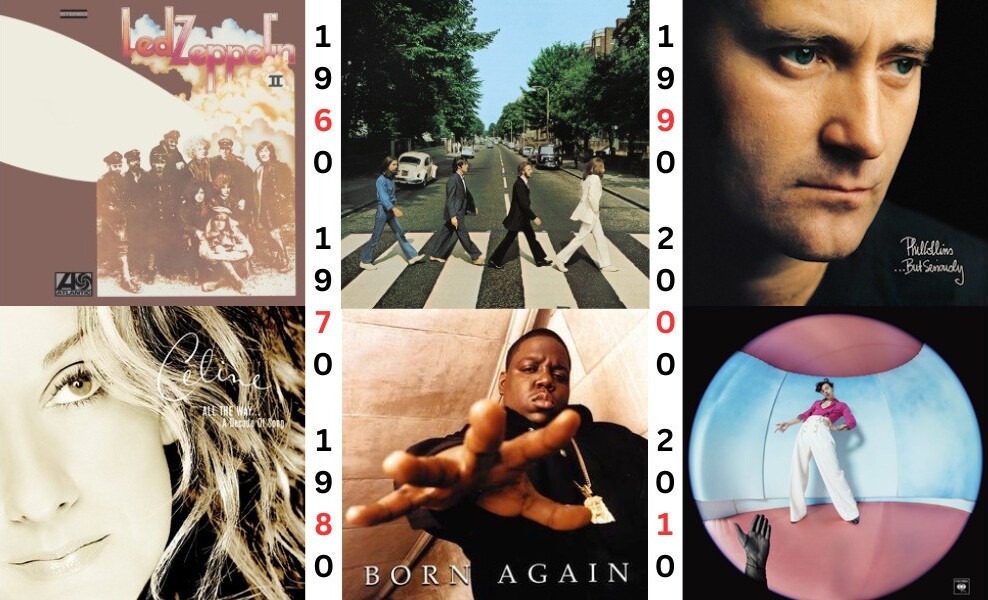
1969: “Led Zeppelin II” – Led Zeppelin
In August 1963, the stereo and mono charts were finally merged to form the Billboard 200. The first artist to top the new chart was Andy Williams with “Days of Wine and Roses and Other TV Requests”, an album that had already dominated both the mono and stereo charts for a few months. His reign on the unified chart lasted just one week, narrowly beating out 13-year-old Stevie Wonder, who claimed No.1 on August 24.
The decade closed on a very different note with the release of “Led Zeppelin II” in 1969. Its heavy, blues-driven rock sound was worlds away from Andy Williams’ smooth traditional pop music that would have been almost unimaginable just a few years earlier.
Read: 10 Interesting Facts about Led Zeppelin
1970s
1970: “Abbey Road” – The Beatles
1979: “The Long Run” – Eagles
The decade began much like the 1960s ended, with The Beatles and Led Zeppelin trading places at the top of the Billboard 200. That back-and-forth lasted until March 1970, when Simon & Garfunkel shook things up with “Bridge over Troubled Water”. The Beatles also returned to the top later that year with “Let It Be”,which held No.1 for four consecutive weeks starting June 13.
The 1970s closed with another rock staple: the Eagles’ “The Long Run”, which dominated the chart for nine straight weeks. Unlike the 1960s, the decade didn’t see a dramatic sound revolution, rather, it saw awesome classic rock albums consistently released one after another.
1980s
1980: “On the Radio: Greatest Hits Volumes I & II” – Donna Summer
1989: “…But Seriously” – Phil Collins
Disco queen Donna Summer opened the decade with her first greatest hits compilation, “On the Radio: Greatest Hits Volumes I & II”. By 1980, disco was already fading, much like classic rock, but this chart-topper hinted that a new wave was on the horizon, even if it wasn’t clear when it would arrive.
The decade ended with another solo powerhouse, as Phil Collins closed out the ’80s with his fourth studio album, “…But Seriously”. Blending pop rock with touches of R&B, it topped charts in more than 20 countries and signaled the new sound that would dominate the 1990s.
1990s
1990: “Girl You Know It’s True” – Milli Vanilli
1999: “Born Again” – The Notorious B.I.G.
If music reflected the decade, then the German R&B duo Milli Vanilli perfectly captured the 1990s – a sensational start, plenty of controversy in the middle, and a tragic end.
The decade closed with the posthumously released compilation “Born Again” by Notorious B.I.G., also known as Biggie Smalls, whose life had been cut short two years earlier at just 24.
The 1990s were as, or even more innovative and fresh than the 1960s – seeing the rise of R&B, grunge, hip hop, and even country stars topping mainstream US charts. Of course, diversity doesn’t equal quality, but the ’90s somehow managed to deliver classic albums across multiple genres, cementing the 1990s as one of the most memorable eras in music history.
2000s
2000: “All the Way… A Decade of Song” – Celine Dion
2009: “I Dreamed a Dream” – Susan Boyle
The Queen of Power Ballads celebrated a hugely successful decade with her greatest hits compilation, released on November 12, 1999, which became the first album to top the Billboard 200 in the new millennium.
The 2000s were defined by pop, R&B, and hip hop dominating the charts, often in cross-genre hits. However, by the decade’s end, country artists like Taylor Swift, Keith Urban, Carrie Underwood, and Reba McEntire were regularly reaching the top of the US Billboard 200.
Despite all the genre-blending, no one could have predicted an operatic pop finale. Susan Boyle, who rose to fame on Britain’s Got Talent, took the world by storm with her debut album, which topped charts in over a dozen countries.
2010s
2010: “Animal” – Kesha
2019: “Fine Line” – Harry Styles
The decade began with one style of pop and ended with another.
Early on, electronic music dominated, helping Kesha’s electropop and dance-pop debut, “Animal”, reach the top of the charts, thanks in large part to her hit single “Tik Tok”. By the end of the decade, classic pop returned with Harry Styles’ catchy pop-rock album “Fine Line” which features hits like “Watermelon Sugar” and “Adore You”.
The 2010s also saw world music break into the mainstream, with “Despacito” becoming one of the defining hits of the era.
2020s
2020: “JackBoys” – JackBoys
2029: ????
Hip hop collective JackBoys kicked off 2020, reminding us that the genre which has been mainstream since the mid-1990s continues to shape culture and shows no signs of slowing down.
Interestingly, while the rise of world music in the 2010s was driven largely by Spanish-speaking artists, the 2020s have seen Korean boy and girl groups dominate, not just in the United States, but worldwide. So it isn’t a surprise that at the halfway point of the decade (2024), the South Korean boy band Stray Kids was at No.1 on the Billboard 200 with their first mixtape “Hop”.
It remains to be seen whether hip hop and K-pop will continue to define the remainder of the 2020s.
Read Next: 16 Shortest Albums to ever top the Billboard 200